

Blog
Astrology compatibility for dating apps: synastry, Kundli matching and zodiac match
· 96Astro API team · 7 min read · Matching
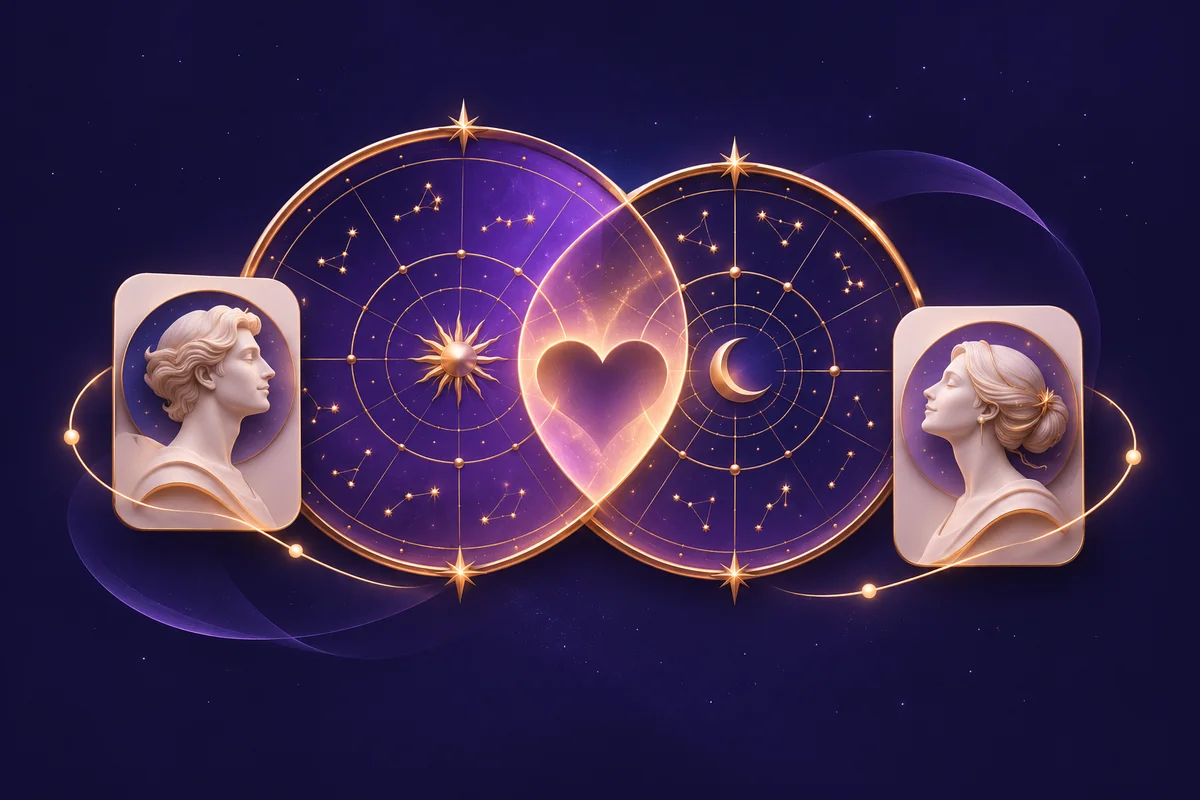
Add astrology compatibility to a dating app: sun-sign match, synastry and Guna Milan, bulk matching at scale, AI couple chat, and design rules that keep it fair and private.
In brief
- Astrology compatibility is one of the most engaging features a dating app can add: zodiac match cards, synastry reports, Kundli (Guna Milan) scores and AI chat about a couple.
- A compatibility API gives you three levels: sun-sign match (only birth dates), synastry (full Western charts) and Vedic matching (Ashtakoot, Manglik, Porutham).
- Scale it with bulk matching: one profile against many in a single call.
- Design it as an opt-in conversation starter, never a hidden filter, and protect birth data like the sensitive information it is.
Dating apps compete on one thing: giving people a reason to start talking. "Your Moon is in his 7th house" or "you share 27 of 36 gunas" does that better than another photo. This guide explains how to add astrology compatibility to a dating app: which kind of matching to use, how to scale it to thousands of profiles, how to design it so it helps rather than harms, and what it costs.
Three levels of astrology compatibility
| Level | Needs | Feels like | Best for |
|---|---|---|---|
| Sun-sign match | Two dates of birth | Instant, playful | Every profile card |
| Synastry (Western) | Date, time and place for both | Deep and personal | Premium reports, "why we click" |
| Vedic Kundli matching | Date, time and place for both | Traditional, method-specific | Indian audiences, matrimony-style apps |
Most apps use all three: a sun-sign badge for everyone, synastry or Kundli matching once both people have added birth details, and a paid full report on top.
Level 1: zodiac sign compatibility for every profile
western-sun-sign-match needs only the two Sun signs ({"sign_a": "Leo", "sign_b": "Aquarius"}), which can usually be derived from birth dates. Near a sign-ingress boundary, calculate the exact solar position using time and timezone rather than relying on a generic date table. That makes it ideal for profile cards, because most users will give a birthday but not a birth time.
- Show a short line on the card: "Aries + Leo: fire with fire".
- Cache by sign pair: there are only 144 combinations, so a few hundred calls cover your whole user base for a language.
- For more depth,
report-star-sign-compatibilityreturns a fuller reading of the pair.
Level 2: synastry for couples who share birth details
Synastry compares two full natal charts: which planets of one fall in which houses of the other, and the aspects between them. The 96Astro Western family covers it in layers:
| Capability | What it gives |
|---|---|
synastry-compatibility | A compatibility score and its parts |
synastry-aspects | The aspects between the two charts |
synastry-chart, synastry-wheel | The data and a bi-wheel drawing |
synastry-emotion, synastry-intimacy, synastry-career, synastry-finance, synastry-spirituality | Readings of one area of the relationship |
synastry-predictions | A narrative reading of the pair |
synastry-full | Everything in one call |
synastry-bulk | One chart matched against many |
A good premium feature is a "why we click" report: the score, the two or three strongest connecting aspects, and one area reading such as emotion. See the synastry API page for examples.
Level 3: Vedic Kundli matching (Guna Milan)
For users who follow Vedic matching traditions, compatibility may include Kundli matching. The matching family covers every common method:
| Method | Capabilities |
|---|---|
| Ashtakoot (36 gunas) | ayu-milan and match-score from birth details; ashtakoot-details and quick-match from the two nakshatras; each koota alone (koota-nadi, koota-bhakoot, koota-gana and the rest) |
| Manglik | manglik-match, with cancellations |
| South Indian | porutham, south-match (Dashakoot with Rajju and Vedha) |
| Deeper | ayu-milan, papasamya, life-stage-match, marriage-sustainability |
| Scale | bulk-nakshatra-match, bulk-south-match, match-one-to-many, aggregate-match |
Show the score out of 36 with the koota breakdown, not just a single number. Users want to know which kootas scored low and whether a dosha is cancelled. Our guide to Ashtakoot vs Porutham explains the differences, and Kundli matching for matrimony sites covers the traditional side in depth.
Matching at scale: one profile against thousands
Calling a pairwise match for every candidate is slow and expensive. Use the bulk endpoints instead:
- Nakshatra-level matching first.
bulk-nakshatra-matchandmatch-one-to-manyscore one person's nakshatra against many at once. For Ashtakoot, most of the score depends only on the two Moon nakshatras, so this is a cheap first pass. - Western bulk.
synastry-bulkmatches one chart against many. - Full matching on demand. Run the detailed match only when two people open each other's profiles.
- Cache pairs. Cache a match under both profile revisions, calculation settings, language and engine version. Invalidate it after a birth-detail correction or calculation update.
Design it as a conversation starter, not a filter
This is the part that decides whether astrology helps your app or hurts it.
- Opt in, both sides. Only show compatibility when both people have chosen to add birth details and to show astrology on their profile.
- Never hide people by score. A low Guna score or a "challenging" synastry should never quietly remove someone from a feed. Let users choose an astrology filter openly, if at all, and label it.
- Show strengths first. Lead with what connects the couple, then the areas to talk about.
- Never reveal one person's birth details to the other. Show the result, not the inputs. A birth date and place can identify someone.
- Photo-based readings are for the user themselves. Palm and face readings must never be used to judge or filter other people. A couple's
palm-compatibilityreading is fine as a fun feature when both people take part.
Let the couple talk to an AI astrologer
ai-match-chat answers a couple's questions from both charts and their matching report: "What should we watch out for in our first years together?", "When is a good time for the wedding?". ai-western-chat does the same for a Western chart. Each answer is grounded in the computed charts, which reduces unsupported claims. Validate referenced placements and do not promise an exact event date. This works well as a paid add-on after a match.
Example: a match card
Full Kundli matching takes both people's birth details:
curl https://api.96astroapi.com/v1/matching/ayu-milan \
  -H "Authorization: Bearer $ASTRO_API_KEY" \
  -H "Content-Type: application/json" \
  -d '{
    "groom": { "datetime": "1990-10-18T14:30:00", "timezone": "Asia/Kolkata", "latitude": 28.6139, "longitude": 77.209 },
    "bride": { "datetime": "1992-03-02T05:47:00", "timezone": "Asia/Kolkata", "latitude": 19.0767, "longitude": 72.8767 },
    "report_type": "half"
  }'
For a fast first pass you only need the two Moon nakshatras and their padas, which you can save on each profile once:
{ "groom": { "nakshatra": "Rohini", "pada": 2 }, "bride": { "nakshatra": "Hasta", "pada": 1 } }
Send that to quick-match or ashtakoot-details for the 36-guna score. Show the total, the eight kootas as small bars, any dosha with its cancellation, and one sentence of summary. Link "See the full report" to a paid PDF.
Monetising compatibility
| Feature | Model |
|---|---|
| Sun-sign badge | Free, drives engagement |
| Detailed synastry or Kundli match | Unlock per match, or in a premium plan |
| PDF compatibility report | One-off purchase |
| AI couple chat | Per question or bundled |
| Wedding muhurta dates | Paid add-on for couples who matched |
The cost per call is small next to these prices; see how to monetise an astrology app for worked numbers.
Privacy checklist
- Birth date, time and place are personal data. Ask for consent before you calculate and before you show anything to another user.
- Store birth data encrypted, separately from public profile data.
- Let users delete their birth details and every stored match with them.
- Do not send birth data to analytics or advertising tools.
Frequently asked questions
What is the best astrology compatibility method for a dating app?
Use sun-sign matching for every profile, because it needs only birth dates, then synastry or Vedic Kundli matching when both people add a birth time and place.
What is synastry?
Synastry compares two natal charts: where one person's planets fall in the other's houses and the aspects between their planets. It is the standard Western compatibility method.
What is a good Guna Milan score?
Some traditions use 18 out of 36 as an initial threshold, but it is not a validated relationship-success probability; but individual kootas such as Nadi and Bhakoot and the Manglik status also matter. Show the breakdown, not just the total.
Can I match one user against thousands of profiles?
Yes. Use bulk-nakshatra-match, match-one-to-many or synastry-bulk for a fast first pass, and run detailed matching only when two people look at each other's profiles.
Should compatibility scores filter who users see?
No. Use compatibility as an opt-in talking point. Hidden filtering by astrology can exclude people unfairly and erode trust.
Can couples ask questions about their match?
Yes. ai-match-chat answers questions from both charts and their matching report.
Get started
Read the matchmaking guide, open the Kundli matching API and synastry API pages, and try a match with a free sandbox key.
Get the next guide by email
One email a month with new guides and API changes. No account needed.
Keep reading
- Ashtakoot vs Porutham: a guide to kundli matching APIs
28 October 2026 · 7 min read
- How to monetise an astrology app: models and cost scenarios
12 November 2026 · 9 min read
- Palm Reading API: how to add AI palmistry to your app
12 November 2026 · 9 min read